Security tokens are part of a broader trend known as asset tokenization or real-world asset (RWA) tokenization. The objective is to represent real-world financial or physical assets digitally while using blockchain infrastructure for ownership records, transfers, settlement, and other functions.
However, a security token is not simply a cryptocurrency with a different name. The legal classification of a token depends on its characteristics, rights, economic substance, and the laws applicable to the issuer and investors.
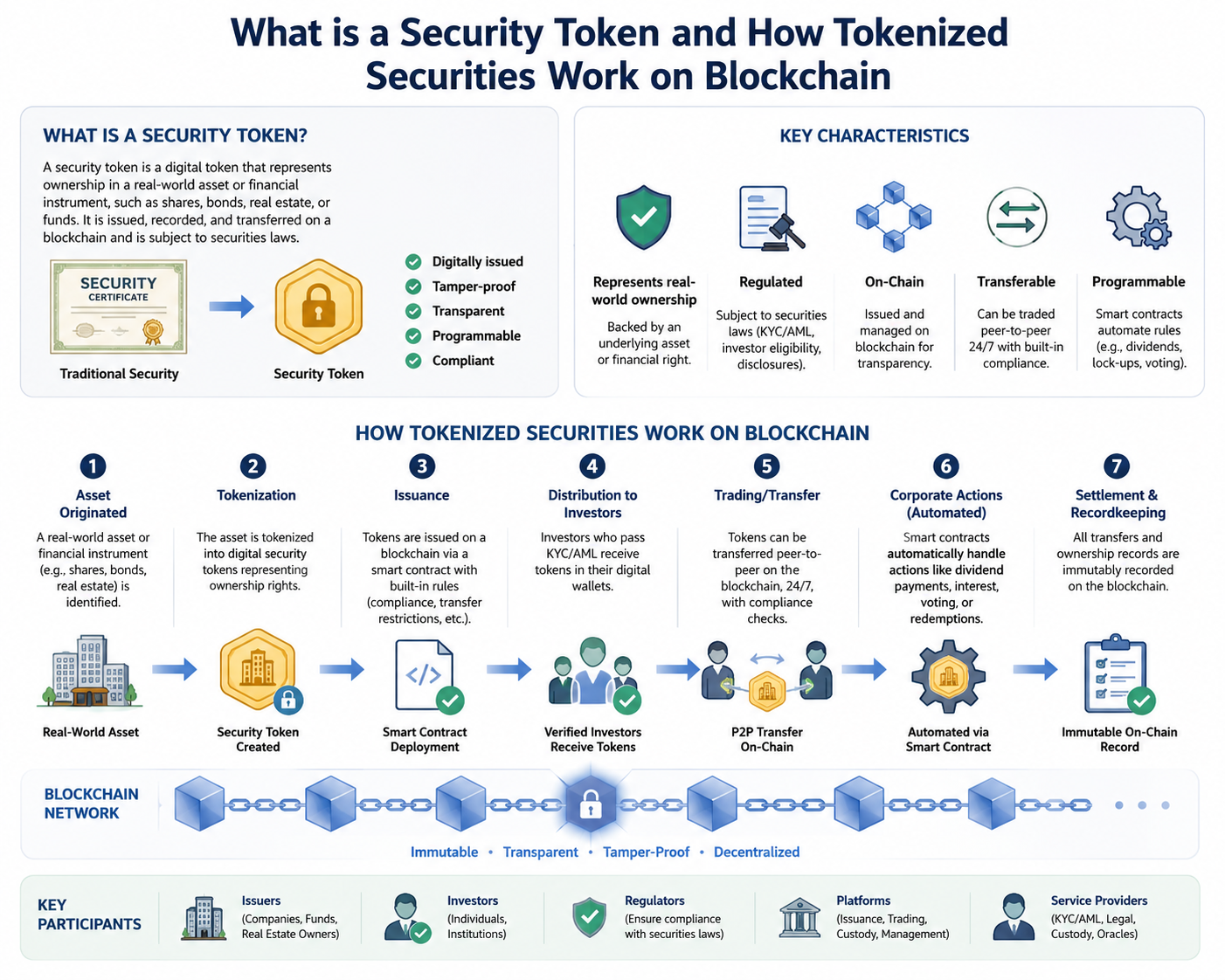
What Is a Security Token in Crypto?
In the cryptocurrency and blockchain industry, a security token is a token that represents an ownership interest, financial claim, or investment-related right.
For example, imagine a company wants to raise capital by offering investors an economic interest in the company. Instead of representing those interests only through traditional certificates or entries in a centralized database, the company could potentially represent them using blockchain-based tokens.
In this model, the blockchain becomes part of the infrastructure used to record and manage ownership or investment rights.
A security token can potentially represent:
- Equity or ownership in a company
- Debt or bonds
- Real estate interests
- Shares in investment funds
- Revenue or profit-related rights
- Other financial instruments or investment interests
The important point is that the token itself is only the technological representation. The legal rights attached to that token are what matter when determining its regulatory treatment.
How Do Security Tokens Work?
Security tokens typically combine several components: an underlying asset or financial interest, a legal framework, a blockchain-based token, and rules governing who can hold or transfer the token.
A simplified security token structure can look like this:
Underlying Asset → Legal Rights → Tokenization → Blockchain → Investor
The underlying asset provides the economic value. Legal documentation defines the rights of investors. The tokenization process creates a digital representation of those rights, and blockchain infrastructure can then be used to record transactions and ownership changes.
1. An Underlying Asset or Investment Interest
The first component is the asset or financial interest being represented.
This could be company equity, a debt instrument, a property interest, or another type of investment.
Without a meaningful underlying right or financial relationship, a token would not automatically become a security token simply because it exists on a blockchain.
2. Legal and Financial Structure
The issuer must determine what rights investors actually receive.
Depending on the structure, those rights could include ownership, voting rights, repayment of principal, interest payments, dividends, revenue participation, or other economic benefits.
This legal structure is critical because blockchain technology does not replace securities law, corporate law, financial regulations, or contractual obligations.
3. Tokenization
The relevant rights or interests are then represented digitally through tokens.
The token may contain or reference rules governing ownership, transfers, eligibility, and other conditions.
4. Blockchain Infrastructure
The token is issued on a blockchain network that supports the required smart contract functionality.
Blockchain technology can provide a transparent and programmable transaction record while allowing ownership to be represented by blockchain addresses.
5. Compliance and Transfer Rules
Unlike many permissionless cryptocurrency tokens, a security token may require restrictions on who can purchase, hold, or transfer it.
Depending on the applicable jurisdiction and offering structure, compliance mechanisms may include investor verification, transfer restrictions, holding periods, geographic restrictions, or other eligibility requirements.
Security Token vs Utility Token
One of the most common questions in crypto is the difference between a security token and a utility token.
| Feature | Security Token | Utility Token |
|---|---|---|
| Primary purpose | Represents an investment or financial interest | Provides access to a product, service, or ecosystem function |
| Economic rights | May include ownership, debt, dividends, or other financial rights | Usually focused on utility or access |
| Regulatory considerations | May be subject to securities regulations | Depends on design and jurisdiction |
| Underlying asset | May represent a company, property, debt, fund, or other investment | Usually represents access or functionality within an ecosystem |
| Transfer restrictions | May be required | Often fewer restrictions, depending on design |
The distinction is not determined simply by the token’s name.
Calling a token a utility token does not automatically prevent it from being treated as a security. Similarly, placing a token on a blockchain does not automatically make it a cryptocurrency in the regulatory sense.
The substance of the arrangement matters.
Security Token vs Cryptocurrency
Cryptocurrency is a broad term commonly used for blockchain-based digital assets such as coins and tokens.
A security token is a more specific concept because it relates to tokens representing financial or investment interests.
For example, a cryptocurrency may primarily function as a medium of exchange, store of value, or network asset. A security token, by contrast, may represent an ownership or investment interest in an underlying asset.
Therefore, security tokens can use the same underlying blockchain technology as other crypto assets while having substantially different legal and economic characteristics.
What Assets Can Be Tokenized?
One of the biggest opportunities associated with security tokenization is the ability to represent different types of assets digitally.
Real Estate
Real estate is one of the most frequently discussed applications of asset tokenization.
A property or property-related investment structure can potentially be divided into digital units representing economic interests in the underlying asset or entity.
This could make fractional ownership structures more practical, although the legal structure remains essential.
Company Equity
Security tokens can potentially represent shares or ownership interests in a company.
In such a structure, token ownership could correspond to rights defined by corporate and securities documentation.
Bonds and Debt
Debt instruments can also be represented through blockchain-based tokens.
A tokenized bond could represent a claim against an issuer and may include terms such as principal, maturity, and interest payments.
Investment Funds
Fund interests can potentially be represented using tokens, allowing blockchain infrastructure to become part of the recordkeeping and transfer process.
Other Real-World Assets
The broader tokenization market also explores the digital representation of commodities, private credit, intellectual property interests, invoices, and other assets.
Not every tokenized asset is necessarily a security. The classification depends on the asset, legal rights, structure, and applicable law.
What Is a Security Token Offering (STO)?
A Security Token Offering (STO) is an offering in which security tokens are issued or sold to investors.
Conceptually, an STO can be compared with a traditional securities offering, except that blockchain technology is incorporated into the issuance, ownership, transfer, or settlement process.
This is an important distinction from an Initial Coin Offering (ICO).
An ICO generally refers to the distribution of blockchain tokens to raise funds, while an STO specifically involves tokens that represent securities or investment interests.
The regulatory requirements for an STO depend heavily on the jurisdiction, offering structure, investor type, and characteristics of the security.
Security Tokenization vs Token Creation
These two concepts are often confused.
Token creation generally means deploying a token smart contract on a blockchain.
Security tokenization is much broader.
It can involve:
- Identifying the underlying asset
- Creating a legal ownership structure
- Defining investor rights
- Determining applicable securities regulations
- Designing investor eligibility requirements
- Creating compliance procedures
- Developing the token smart contract
- Implementing transfer restrictions where required
- Managing investor records
- Establishing issuance and redemption procedures
Therefore, deploying a BEP-20 or ERC-20 smart contract does not by itself create a legally compliant security token offering.
Why Use Blockchain for Security Tokens?
Blockchain technology offers several characteristics that can be useful for digital securities.
Transparent Transaction Records
Blockchain networks can provide publicly verifiable transaction histories, depending on the network and privacy architecture used.
Programmability
Smart contracts can automate certain actions according to predefined rules.
For example, a token contract may enforce transfer restrictions, interact with other contracts, or implement predefined settlement logic.
Faster Settlement
Traditional financial transactions may involve several intermediaries and settlement systems. Blockchain-based infrastructure can potentially simplify some parts of this process.
Fractionalization
Tokenization can make it technically easier to divide certain asset interests into smaller digital units.
However, technical fractionalization does not automatically mean that an asset is legally divisible or available to every investor.
Global Infrastructure
Public blockchains operate across borders, creating potentially global infrastructure for digital assets.
At the same time, this characteristic creates regulatory challenges because securities laws are generally jurisdiction-specific.
What Are the Benefits of Security Tokens?
Security tokens can potentially provide several advantages over conventional asset management and settlement infrastructure.
Greater Transparency
Blockchain transaction data can make certain ownership and transfer activities easier to verify.
Programmable Compliance
Smart contracts can potentially automate selected compliance and transfer rules.
Operational Efficiency
Tokenized infrastructure may reduce manual processes associated with certain types of issuance, transfers, and recordkeeping.
Fractional Ownership
Tokenization can allow an investment structure to represent smaller units of ownership or economic participation.
Potentially Broader Market Access
Depending on the legal structure and applicable regulations, tokenized assets could eventually make certain investment products easier to access through digital platforms.
What Are the Risks of Security Tokens?
Security tokens also introduce significant risks.
Regulatory Risk
The biggest consideration is often regulatory compliance.
A token can be technically functional while its issuance, marketing, distribution, or trading creates legal problems.
Smart Contract Risk
Security tokens rely on software. Bugs in smart contracts can potentially result in incorrect transfers, locked assets, unauthorized actions, or other problems.
For this reason, smart contract development, testing, code review, and security auditing can be important components of a serious tokenization project.
Custody Risk
Investors still need to protect their private keys and wallets. Losing access to a wallet can create problems even when the blockchain itself continues operating normally.
Liquidity Risk
Creating a token does not automatically create a liquid market.
A tokenized security may have limited buyers, restricted transfers, or no active secondary market.
Issuer Risk
The value of a security token may ultimately depend on the financial condition and performance of the issuer or underlying asset.
Are Security Tokens Legal?
Security tokens can be legal when they are issued and distributed according to the applicable legal and regulatory framework.
However, there is no universal rule that makes every security token legal simply because it operates on blockchain technology.
Different countries have different definitions, exemptions, registration requirements, investor protection rules, reporting obligations, and restrictions.
Businesses considering a security token offering should obtain appropriate legal and regulatory advice in the jurisdictions where the offering will take place.
Important: This article is provided for educational purposes only. It is not legal, financial, investment, tax, or regulatory advice. Anyone planning to issue or distribute a security token should consult qualified professionals familiar with the relevant jurisdiction.
Security Tokens and RWA Tokenization
RWA tokenization means representing real-world assets or interests in those assets using blockchain-based tokens.
Security tokens are one important part of this broader trend.
For example, tokenization could involve an investment interest in real estate, corporate debt, private credit, or another traditional financial asset.
The token becomes a digital representation of an underlying legal and economic relationship.
This distinction is important because not every RWA token is necessarily a security token. Some tokenized assets may have different legal classifications depending on their structure.
How Is a Security Token Created?
Creating a security token involves considerably more than deploying a smart contract.
A typical process may include the following stages:
- Define the underlying asset or investment.
- Determine the rights attached to the investment.
- Analyze the applicable regulatory requirements.
- Design the legal and corporate structure.
- Determine investor eligibility and transfer restrictions.
- Design the token economics.
- Develop the smart contract.
- Test and review the smart contract.
- Deploy the token on the selected blockchain.
- Implement the required compliance and investor procedures.
- Launch the offering according to the applicable rules.
The blockchain development component is therefore only one part of a complete security token project.
Which Blockchain Can Be Used for Security Tokens?
Security tokens can potentially be implemented on different blockchain networks that support programmable smart contracts.
Common blockchain environments include EVM-compatible networks, where smart contracts can be developed using technologies compatible with the Ethereum Virtual Machine.
The choice of blockchain depends on factors such as:
- Transaction costs
- Network reliability
- Smart contract capabilities
- Wallet compatibility
- Developer ecosystem
- Security considerations
- Regulatory and compliance requirements
- Investor accessibility
- Transfer and custody infrastructure
The cheapest blockchain is not necessarily the best blockchain for a regulated financial product. Infrastructure requirements should be evaluated together with the legal and operational model.
Security Tokens vs NFTs
Security tokens and NFTs are both blockchain-based assets, but they serve different purposes.
An NFT generally represents a unique digital or physical item, while a security token represents an investment or financial interest.
For example, an NFT could represent a unique digital collectible. A security token could represent an investment interest in a company or real estate structure.
However, an NFT can potentially have characteristics that create regulatory issues as well. The technical format of an asset does not determine its legal classification by itself.
Security Tokens vs Stablecoins
A stablecoin is generally designed to maintain a relatively stable value relative to another asset, such as a fiat currency.
A security token, on the other hand, represents an investment or financial interest.
Therefore, the two concepts have fundamentally different objectives, even though both can be implemented using blockchain technology.
Why Security Tokenization Matters for the Future of Finance
Traditional financial markets rely on established systems for issuing, recording, transferring, and settling securities.
Blockchain introduces an alternative technological architecture in which ownership and transaction records can be represented digitally on a distributed ledger.
This could eventually change how certain financial assets are issued and managed.
The potential transformation is not necessarily about replacing every existing financial system with blockchain. Instead, blockchain may become another infrastructure layer used for specific markets and financial products.
The most important developments are likely to involve the combination of:
- Blockchain infrastructure
- Smart contracts
- Digital identity
- Investor compliance
- Tokenized assets
- Digital custody
- Automated settlement
- Regulated trading infrastructure
Common Misconceptions About Security Tokens
“Every Token Is a Security Token”
False. Tokens have different purposes and structures. Whether a token is considered a security depends on its characteristics and applicable law.
“Putting a Token on Blockchain Makes It Legal”
False. Blockchain is a technology. It does not eliminate regulatory obligations.
“A Utility Token Label Prevents Securities Regulation”
Not necessarily. The substance of the token and the economic relationship can matter more than the terminology used by the issuer.
“Security Tokens Automatically Have High Liquidity”
False. A tokenized asset still needs a functioning market, eligible buyers, appropriate infrastructure, and sufficient demand.
“Tokenization Means Fractional Ownership Is Automatically Legal”
Not necessarily. Blockchain can technically divide an asset into tokens, but the legal rights represented by those tokens still need to be properly structured.
Frequently Asked Questions About Security Tokens
What is a security token?
A security token is a blockchain-based token that represents an investment, ownership interest, debt claim, or other financial right that may be subject to securities regulations.
What is a security token in crypto?
In crypto, a security token is a digital token representing a financial or investment interest using blockchain infrastructure.
What is the difference between a security token and a utility token?
A security token generally represents an investment or financial interest, while a utility token is primarily designed to provide access to a product, service, or function within an ecosystem. The actual legal classification depends on the token’s structure and applicable law.
What is an STO?
STO stands for Security Token Offering. It generally refers to an offering involving tokens that represent securities or investment interests.
Can real estate be converted into security tokens?
Real estate interests can potentially be represented through tokenization structures. However, the legal ownership structure, investor rights, securities requirements, and property laws must be addressed before an offering is launched.
Are security tokens the same as cryptocurrencies?
No. Security tokens use blockchain technology but represent a specific category of financial or investment interest. Cryptocurrency is a broader term covering many types of blockchain-based digital assets.
Can security tokens be traded?
Potentially, but trading may be subject to investor eligibility, transfer restrictions, securities regulations, approved trading venues, and other requirements.
Can a security token be created using an ERC-20 or BEP-20 smart contract?
A tokenized financial interest can technically use common blockchain token standards, but using an ERC-20 or BEP-20 contract does not by itself make the security token legally compliant. Compliance requirements must be addressed separately.
Is security tokenization the same as RWA tokenization?
Not exactly. Security tokenization can be considered one category within the broader RWA tokenization ecosystem. Some tokenized real-world assets may have classifications other than securities.
Is a security token a good investment?
There is no universal answer. Security tokens can have different risks depending on the underlying asset, issuer, legal structure, liquidity, valuation, and market conditions. Investors should conduct independent due diligence and obtain professional advice when appropriate.
Conclusion: What Is a Security Token?
So, what is a security token? In simple terms, it is a blockchain-based representation of an investment or financial interest.
Security tokens combine traditional financial concepts with blockchain infrastructure. They can potentially represent equity, debt, real estate interests, investment funds, and other assets while using smart contracts and distributed ledgers to manage digital ownership and transactions.
However, the most important lesson is that security tokenization is much more than creating a cryptocurrency token.
A successful security token project requires consideration of the underlying asset, investor rights, legal structure, regulatory obligations, smart contract security, custody, transfer restrictions, and market infrastructure.
As blockchain technology continues to develop, security tokens and tokenized real-world assets could become an increasingly important part of digital finance. The technology provides new possibilities, but responsible implementation requires both strong technical infrastructure and appropriate legal and regulatory planning.
Understanding the difference between token creation, tokenization, and regulated security issuance is therefore essential for anyone exploring the future of blockchain-based finance.
